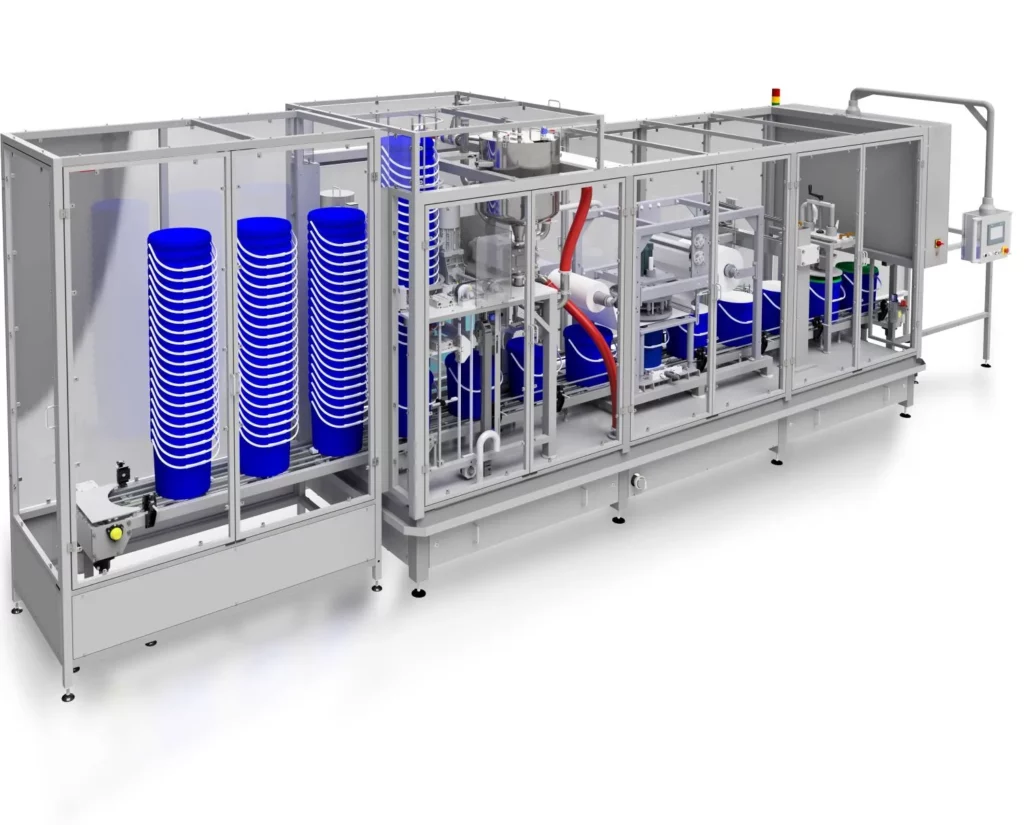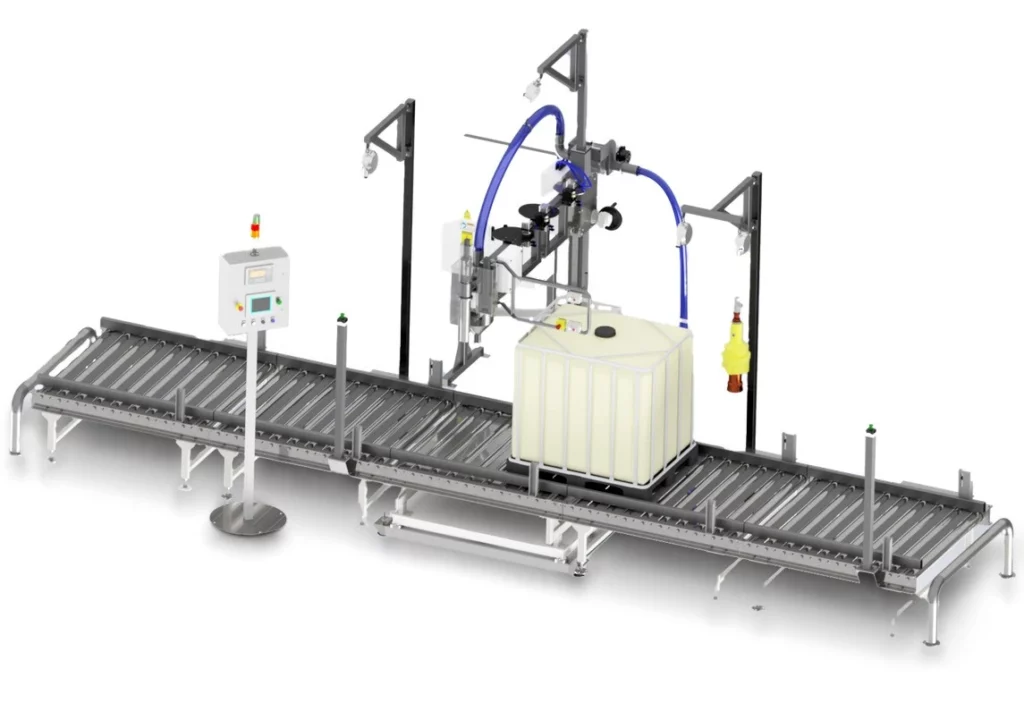
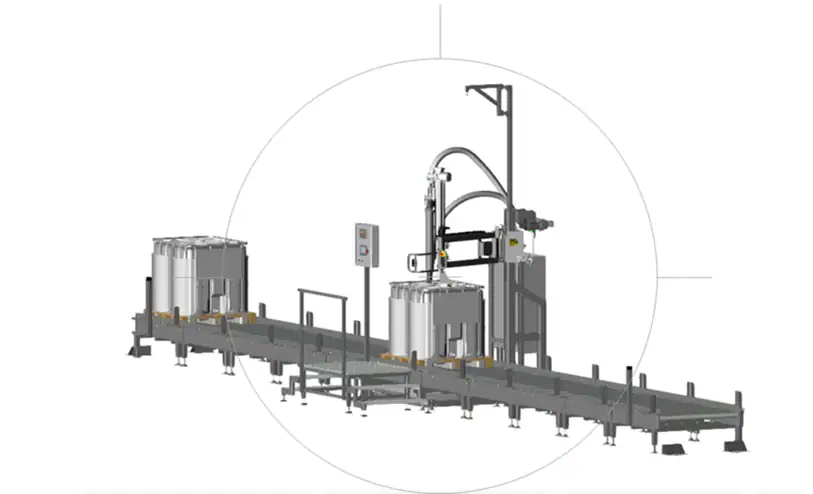
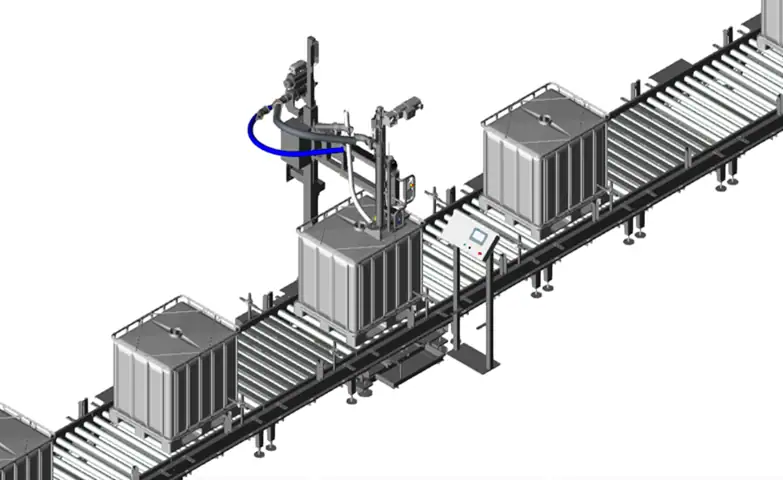
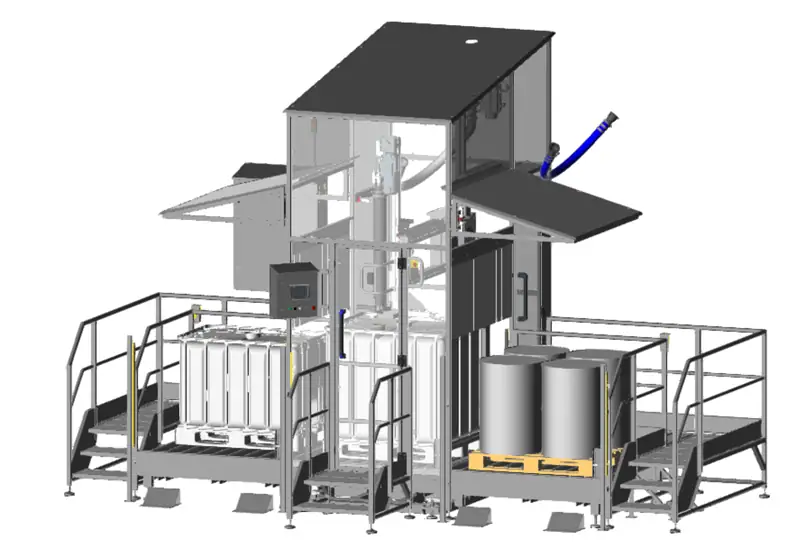
The pallet filler is designed to fill 50–200-liter drums, canisters, and 1,000-liter IBC containers on pallets and to seal them with screw-on or press-on caps.
Drum and IBC container filling systems typically consist of a series of roller conveyors. Pallets with containers are introduced via infeed columns and opened with special pneumatic devices. In a second step, all containers are filled using nozzles on flexible arms. The filling is controlled by static scales (up to 1,500 kg). After all containers are filled, the pallet with the drums or IBCs is automatically transported to the filling and labelling area.
The The filling line capacity is up to 60 drums or 12 IBC containers per hour. These machines are most commonly used for filling motor oil, adhesives, chemicals, or fertilisers.
Key features
- Stainless steel weighing platform with cover plate
- Articulated nozzle support arm for nozzle positioning
- Nozzle height adjustment by handwheel or motor
- Immersion filler neck
- Pneumatic sealing of the filling nozzle
- Drip tray under the filler neck
- Product supply line with proportional valve or pump
- Pneumatic locking head on the balancer
- Siemens SPS with TS
Options
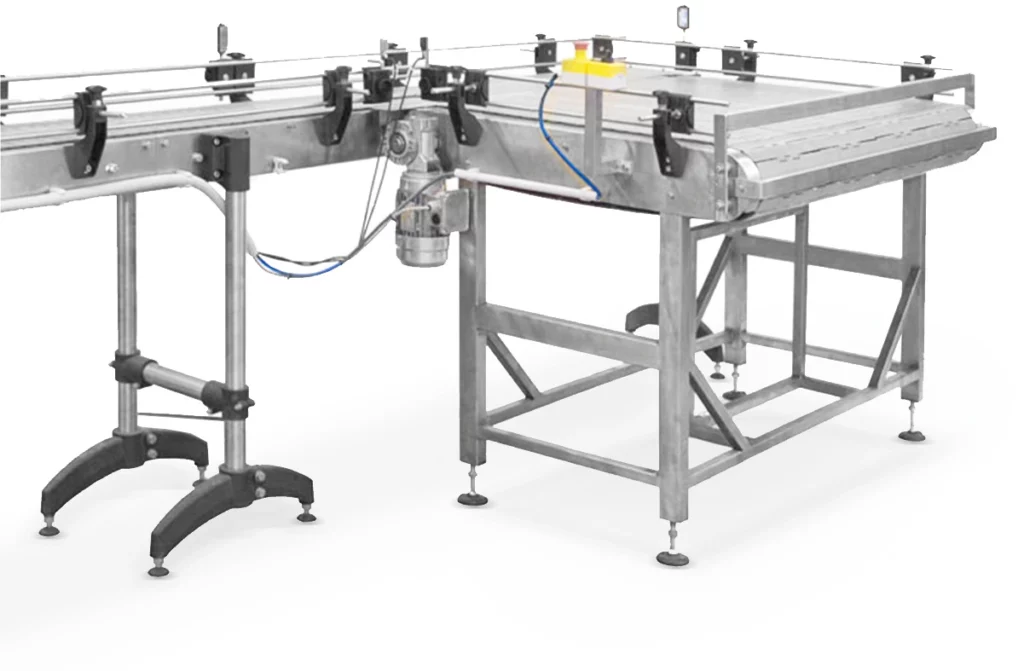
- Pallet feed and discharge belt system
- Motorised bottom-filling lance
- System for heating hoses for hot filling
- Barrel labelling system
Process Description
- The pallet with barrels or IBC containers is placed onto the scale by forklift, or with an automatic pallet feed, it arrives at the filling position via the conveyor belt. The scale performs the taring. The operator then moves the nozzle, located on the movable arm, over the barrel opening and presses the buttons to activate the arm brakes. The arm is then fixed in this position and the nozzle is lowered into the barrel opening.
- The filling process begins. As the preset weight is nearly reached, the proportional valve and filling nozzle partially close, and when the desired weight is attained, the valve and nozzle close completely and the nozzle can be moved to the next barrel. Once filling is complete, the barrels are sealed using capping tools. The pallet of filled and sealed barrels then leaves the position on the conveyor belt or can be collected by a forklift.